
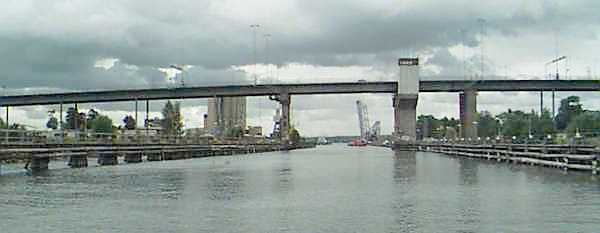
Free height 15,5 meter. The flap is 49,5 meter and it is 17,3 meter wide. The brigde was built by Skånska Cementgjuteriet. It is a bascule bridge and was ready for use in 1963. At that time it was supposed to be the longest bridge of this type in Europe. © Picture by Bosse Arnholm, 2000.

Free height 2,0 meter. The fairway is 30 meter wide here. This single lane railroad was built 1916 to 1917 by the German company J. Gollnow & Son. The bridge can be opened. © Picture by Bosse Arnholm, 2000.
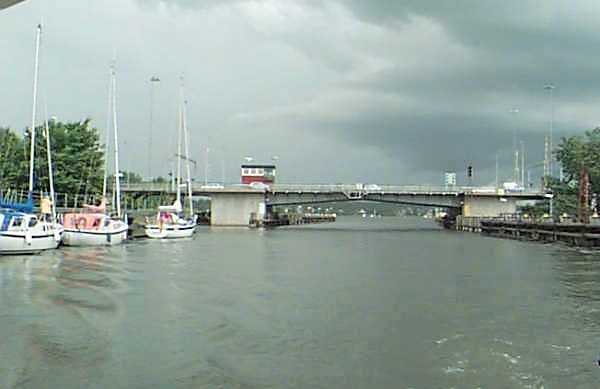
Free height 4,0 meter. Width 30 meter. Opening. It was ready for use in 1965 and is a dubble bascule bridge. The old Gropbron from 1912 is some hundred meter to the south and that was a swingbridge. You can still see the foundations when passing. © Picture by Bosse Arnholm, 2000.

|
Here are more picture of the bridge when it opens.. |
|
|

Height 10 meter. Width 26 meter. Opening. This bridge was built 1923 to 1926. © Picture by Bosse Arnholm, 2000.
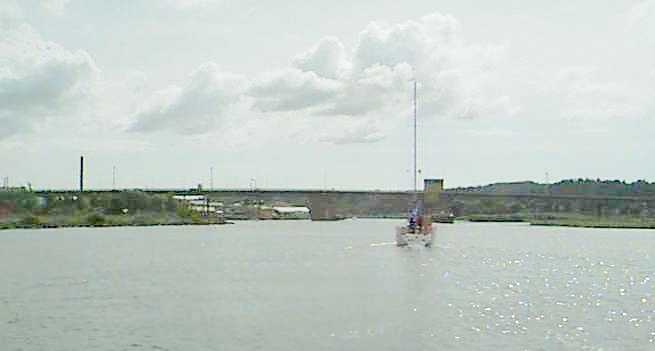
Free height 11 meter. The fairway is 40 meter wide. The bridge opens. It was built by Skånska Cementgjuteriet and was ready for use in 1966. The bridge itself is 700 meter long and has two opening flaps. The German company MAN delievered the machinery. © Picture by Bosse Arnholm, 2000.
Färjelinje över Göta älv vid Bohus-Jordfallet, Old ferry-line across Göta Älv at Bohus
Most likely this is a very old ferry-line.When the new Jordfall bridge was opened the ferry line was closed. By the end there were two parallell cable ferries going all around the clock to cope with the traffic. As far as I know this was the only place in Sweden with twin ferries like this. There are of course some stories about drunken ferrymen not knowing which side of the river they were on.
The first ferry I know of is 62/25 in traffic from 1924. It loaded 13 ton. In September 1953 ferry 62/192 came here and in May 1959 feery 62/241. It's probabel that 62/25 and 62/192 worked parallell between 1§953 and 1959 and 62/192 and 62/241 parallell between 1959 and 1965.
There are information about that 62/24 has been on this route from 1951 to 1953.
On the western shore there are still remnants of roads to the ferries. On the eastern shore all traces were removed in the 1960ies.
Text written by ferry-expert Pär Johansson ©
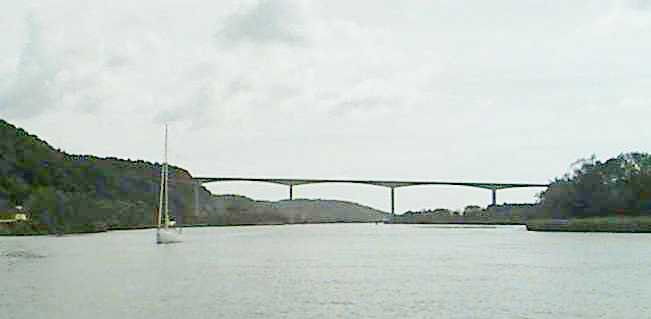
Height 47 meter. © Picture by Bosse Arnholm, 2000.
Färjelinje över Göta älv vid Agnesberg-Nyebro, Ferry across Göta Älv at Agnesberg-Nyebro
Discontinued at December 3 1978 when Angered bridge was opened.
Vägverket ran this ferry-line until January 1 1967, when the municipality took over management untill the line was closed.
The first ferry I know of was 62/23, loading 6 ton. 19530701 ferry 62/183 (14x6 m) came here, 1961 - 1962 62/200 (14x6 m) was here and after that 62/185 (17x7 m) until 19750701. The last years ferry 62/232 (17x7 m) was here. Between 1967 and 1978 the municipality leased the ferries from Vägverket.
Text written by ferry-expert Pär Johansson ©
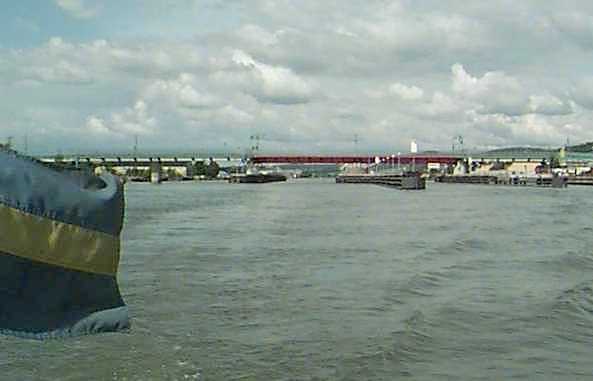
Railroad bridge across Göta Älv in Gothenburg. Totally renovated in 1999 to 2000. The fairway is 22,5 meter wide, free height is 5,9 meter. Can be opened for free height. © Picture by Bosse Arnholm, 2000.

Tingstad tunnel from west. © Picture by Bosse Arnholm, 2000.
This bottleneck in Gothenburg-traffic was opened in 1968 after four years of construction. The decision to build the tunnel was taken in 1958. Today more than 100 000 cars pass every day.
The tunnel is 14 meter below the water surface and it is 454 meter long, with a ramp of 60 meter on each side. There are actually four tunnels. Two for traffic which are 12,5 meter wide and 4,5 meter high. Between these two is one 2 meter wide service-tunnel and above this a tunnel for ventilation.

Unden passes under the Göta Älv Bridge. © Picture by Bosse Arnholm, 1999.
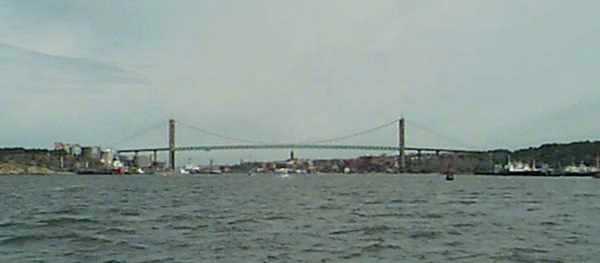
This bridge was inaugurated in 1966. © Picture by Bosse Arnholm, 2000.
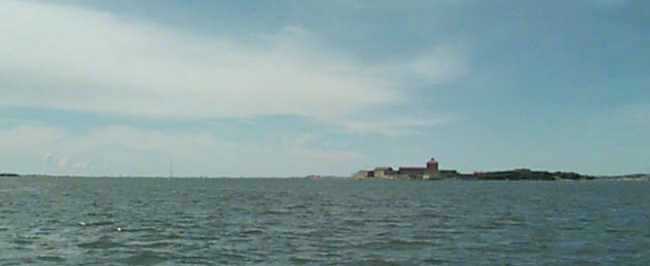
The New Älvsborg fortress at the Göta Älv mouth sends a last greeting to all who have passed Göta Älv and now head towards the open sea.
© Picture by Bosse Arnholm, 2000.
 Click here to get back to the Trollhätte canal page.
This page was modified at


