
The projects in Puhos
Puhoksen kanavahanke
The people in northern Kareliawere very interested to improve the traderoute to lake Ladoga via lake Orivesi, lake Puhos and lake Pyhäjärvi. TThis inspite the fact that the route from Joensuu to Savonlinna had been improved during the 1860ies. A canal between Ladoga and Pyhäjärvi, but this project proved too expensive.
The business man A.J. Mustonen started to plan a canalization of Puhos falls. He owned the sawmills at Phus and Utra making the costs for transports. Mustonen planned a canal in Puhos and a private railroad between lake Pyhäjärvi and Ladoga. He wrote a petion about this in 1875.
The National board encouraged this. According to Mustonens plan the canal at Puhos would be 600 meter long and 1,78 meter deep. The lock would be built in timber and a shipsyrad would be built by the canal. The plan was accepted by the end of 1876 and works started soon afterwards.
The canal digging started at the pyhäjärvi end. The works went on rapidly and about 400 meter of the canal was almost completed as well as the place for the lock, when Mustonen suddenly died and all works stopped. During the following decade at least three attempts were done to continue the canalworks, but none of these were successful.
Local people call it the Mustonen canal.
The clearing up of Puhos falls
Between 600 and 700 towards northest of the Mustonen canal are the Puhos falls. The Baron and major general Carl von Rosenkampf was head of the board for clearing up of falls in Finland from 1827 to 1846. He proposed a clearing up of Puhos falls to lower the level of lake Pyhäjärvi by five feet. This would create culivable land around the lake.
The works started in 1828. The works stopped in 1831 but continued in 1834 and were completed in 1839 when a new furrow hade been completed at the lower parts of the falls.
While these works proceeded the saw mill and other mills were moved downstreams. Today there is a powerplant by the dam.
Today there is also a drawing engine to move boats between the two lakes. Unfortunately it is used very seldom inspite the fact that there are marked fairways in lake Phyäjärvi now adays.. The carriage runs on rails, but you need a tractor to draw the carriage.
Tarmo Hurskainen
Pictures from Puhos falls

| 
| 
| 
|
The canal to the powerplant.
| The canal to the powerplant.
| The pedastrian bridge over the canal.
| Puhos mill still uses power from water.
|
© Pictures by Riitta Kankkunen, 2006

| 
| 
| 
|
Puhos mill and a bridge.
| The canal to the power plant and the mill.
| Overview of the area with the power plant and the drawing carriage used to move timber and boats between the lakes.
| Puhos power plant.
|
© Pictures by Riitta Kankkunen, 2006

| 
| 
| 
|
Nils Ludvig Arppe relief at the wall of the power plant.
| The drawing carriage and the rails.
| The rails covered by snow.
| No ice on the falls during winter.
|
© Pictures by Riitta Kankkunen, 2006

| This is where lake Orivesi starts.
Puhos board factory and sawmill in the backgorund.
© Picture by
Riitta Kankkunen, 2006
|

| 
| 
|
The Iron canal towards the lake Pyhäjärvi in Puhos. Timber floating continues when the wood has been moved over the narrow neck of land.
| The Iron canal towards lake Orivesi.
| The wood has moved over the neck of land.
|
© Pictures 2010 by Pentti Sorsa
| 
| 
|
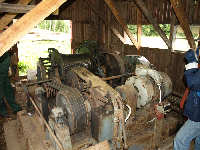
The machine and winch needed to move the wood.
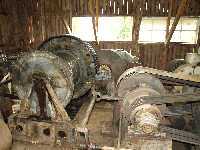
| The machine and winch needed to move the woodt.
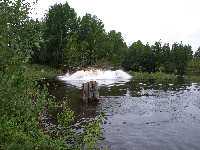
| Wood in the lake Orivesi.
|
© Pictures 2010 by Pentti Sorsa
Source: Turkka Myllykylä, Suomen kanavien historia. Otava 1991.
Do send comments or further information to Bosse Arnholm
 Click here to get back to the startpage.
This page was modified at


